Palm Sunday of the Lord’s Passion, Year A
Previous Years: 2022 (C) || 2021 (B) || 2020 (A) || 2019 (C) || 2018 (B)
Preached at the Church of the Assumption in Bellingham, WA
Recording
https://moorejesus.podbean.com/e/the-crucifixion-was-real/
Transcript
In October of 312 A.D., the Emperor Constantine engaged in a battle at the Milvian Bridge. It’s said that the night before he went to fight his opponent Maxentius at this battle, he saw in the sky a sign, either of a cross or a chi-rho, but a sign that represented Christ himself. And he heard “in hoc signo vinces”, which is to say, in this sign you will conquer. So, Constantine was successful in this battle and became the sole emperor of the West.
Having done so very shortly after that, he published something called the Edict of Milan in 313 AD, which legalized Christianity for the first time in 300 years. Christians were free to worship without threat of persecution and death. Constantine’s mother, Saint Helena, was herself a Christian, and so shortly after the legalization of Christianity, she undertook a pilgrimage to the Holy Land on the orders of Constantine, to try to discover and re-establish the different sites of Christian worship in the Holy Land. The Christians, since the time of Jesus, had been maintaining worship at the sites of His death birth, and resurrection, as well as the different places where he had celebrated miracles. But the Romans, in order to try to quash the Christian cult, forbade worship at these sites. They began to build pagan temples on top of them in order to try to essentially force the Christians into pagan worship. Fine, if you’re going to keep worshipping here, here’s a temple to Venus, worship her.
So Helena goes to the Holy Land. She speaks with the Christians present who have maintained an unbroken tradition of where these sites are, because they have been worshipping there in secret and begins to pull down these pagan temples. At Golgotha, it is said there was a temple of Venus. As she pulls down this temple on this hill where Christ was crucified, they discover under the ground three crosses, just like the cross is described in the Gospel. And now there’s this question: are these the crosses of Christ and the two who are crucified on either side of him? And if they are, how can we tell which one is the true cross? Saint Helen didn’t want to just guess, and so they asked, how can we get a sign from the Lord? They determined there was a woman very close to death in the city. They brought her to these crosses, and they touched her to each of these three crosses. After she touched the final cross, she was immediately miraculously healed. The Christians at the time, including Saint Helena, took it as a sign that this is the true Cross of Christ. This was in 327 A.D. or 326 A.D.or thereabouts. Saint Helena split the cross into a few pieces, one kept in Jerusalem, another sent to Rome.
In this cross she also found three nails. Three nails like the nails that would have been going through Jesus’s two hands and feet which would have shared a nail. She sent two to her son, which I think it was rather selfish of her. Her son put one in his helm and one in the bridle of his horse, so that he would continue to be victorious in battle as he was the first time he battled under the sign of Christ.
The third nail she sent to Rome, and as she returned from the Holy Land to the city of Rome, she established on the Constantinian estate on the edges of the city of Rome a palace for herself. It was already established, but she began to live there, and in part of this palace she established a church. In this church she put the relics that she brought from the Holy Land, relics of the True Cross and this nail that she brought back with her. She also brought back soil, lots and lots of soil/land/dirt from the Holy Land which she spread on the floor of this basilica. This basilica still stands today in exactly the same spot at Saint Helena’s estate.
In this facility today are the relics that Saint Helena brought back. You can still go to Rome, to the Basilica di Santa Croce, and you can still see relics of the True Cross, the wood of the True Cross. You can see one of the nails driven through the hands or the feet of Jesus, and spines from the crown of thorns. Also in this reliquary is said to be the finger of Saint Thomas, which he put in the side of Christ, and the crossbar of the cross of the good thief.
Now, I suppose you may have doubts about whether the nail that Saint Helena brought back was truly the nail of Christ, that the cross found was truly the cross of Christ. There was a 300 year gap and you might not believe that the Christians were able to maintain an oral tradition for that long. I myself believe that it is unquestionable, that the historical record has no gaps in it and the nail that we can see in Rome today is the same nail that Saint Helena brought back. And if you, like me, believe that Saint Helena found the true cross, then you believe that that is the nail that went through the hands or the feet of Jesus.
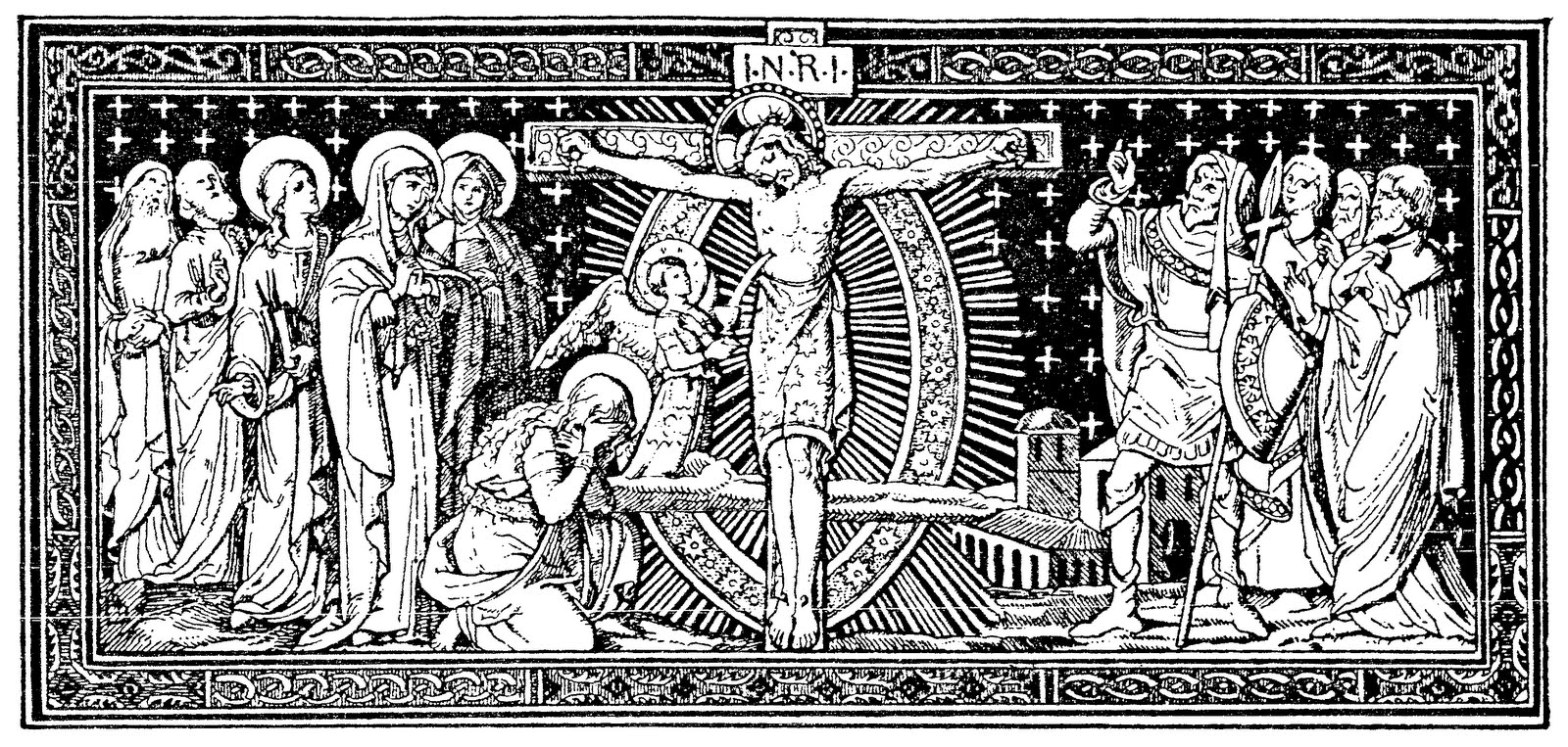
My friends, the passion narrative that we’ve just heard is not a myth. It’s not a made up story. It’s not a moralistic tale. This is history. This happened to a man born in Palestine who lived and died in Palestine at the hands of the Romans and rose from the dead. Jesus Christ suffered for us. If we reflect on the Shroud of Turin, we realize this is the true burial shroud of Christ. You can see all of the wounds on the back of Christ, on his back and on his legs. We know His skin is torn over and over and over again and you can see the blood stains on this shroud. He would still have been bleeding even after death, soaked in to this piece of fabric. You can see on his head the wounds of the crown of thorns. Those spines an inch and a half long and very sharp. This really happened. He actually did it. He was really in the garden praying that He wouldn’t have to undergo such pain and such torment saying “Lord, Father, if this is your will, thy will be done”. He knew that his whole reason for becoming a human being and living on earth was to save us from our sins. And He knew that if this is what was necessary, He would go through it, because the only thing that He cared about, his absolute passion, was to save us from our sins. So He allowed himself to be scourged at a pillar. He allowed his hands and his feet to be pierced by a nail that I can tell you by having seen it, is not very sharp. It would have been incredibly painful. He allowed himself to die on a cross, thought of as a criminal. Hanging above His head, a sarcastic sign that here we the Romans, have killed the king of the Jews. We’ve put him on a cross next to criminals.
The Lord did all of that for us and He really, truly did it. We read this passion every year because we have to remember the price of our salvation. Our salvation was not free and it was not easy. God had to become a human being and then at our hands, because of our corruption and our sin, the Lord suffered more than anyone has suffered. Not just physically, but with the existential pain of carrying all of our sins. He suffered, and He died on a cross as a criminal. The Lord loves us unconditionally but I never want us to think of that love as soft. The love of the Lord is self-sacrificial. It is absolute. It carries with it a heavy price. This is the love that all of us are called to show to the Lord and to each other. The love of Jesus Christ, who allowed himself to be scourged and pierced and tortured. This is the law that we follow. And somehow, in the great mystery of God, through all of this suffering and pain, we find the greatest fulfillment, the greatest love, the greatest transcendence we will ever know. We come together each Sunday to celebrate the passion of our Lord Jesus Christ on this altar, and in so doing, we receive the presence of God in our lives. It’s incredible that the Lord did this for us, and I hope we never numb ourselves to the reality of his passion.
 Fr. Moore