22nd Sunday in Ordinary Time, Year C
Preached at Assumption Parish in Bellingham, WA
Previous Years: 2019
Recording
https://moorejesus.podbean.com/e/christian-hierarchy/
Transcript
I want you to consider the concept of hierarchy. A lot of people have a lot of different relationships with that concept. It is the concept of having a system that is ordered where you have people in a higher place and you have people in a lower place. And that’s what we have in the gospel today. We have people in a higher place and we have people in a lower place. But depending on how we interact with that idea, how we think about the concept of hierarchy, how it has affected us, we’re going to have different reactions to that system. And I would posit that there are two ways to approach the question of hierarchy. We can either approach it as a human invention or we can approach it as something somehow built into the nature of the universe by God himself.
Now, if we approach hierarchy as a human invention, then our response to this gospel isn’t going to be to say we have to make sure that some people are in the high place and some people are in the low place. Our response is going to be to suggest just building a round table, letting everybody have the same access to the guest of honor. Why is that so hard? And typically, that’s our approach to the question of hierarchy as Americans, because as Americans, we have this founding narrative of equality. (Of course, we have failed at that narrative in so many ways, but I am not going to rehearse those here).
Inherent to our founding narrative is the idea of inherent equality. Everybody is created equal. All men are created equal. That’s the phrase that every student has to learn in school. And so if they’re all created equal, then a hierarchy, and particularly a human-created hierarchy, is a threat to our concept of the universe. We have to do everything we can to tear it down. We have to do everything we can to make sure that everybody is the same. There’s a lot of merit to that. There’s a lot of good things that have happened in our country because of that constant pursuit to live up to those words that all people are created equal.
However, the other approach to this question is that there’s something inherent in the universe that always creates hierarchies. That to constantly try to tear down this order of things is vain. What do I mean by that? Well, let’s say you start with a system where everyone is equal. Let’s continue the political analogy. You have all the individual voters. They assemble to make different cities, and those cities make up counties and those counties make up states and those states make up a nation. Well, at every level of that, somebody has to have more power than other people. If you’re going to organize a group of people, you have to have a mayor and then you have to have a county executive and then you have to have a governor. And just by the nature of their work, they have more power. They have more power than I do as an individual citizen. They are entrusted with that power because it is necessary for them to do the work given to them.
Or another example: as much as we like to talk in the United States about a meritocracy, where if you just work hard enough, you can make it, we have seen an inequality of wealth increasing over the last few decades. And part of this is generational wealth that continues onward and that allows for more educational opportunities. And so there ends up being a hierarchy of wealth that just develops despite our best efforts, despite the founding narrative of our country. It’s just there. There are people with more economic power than others. That’s just what develops. So again, you can say this is bad and that we should do everything we can to tear down any sort of inequality of power. And again, there’s a lot of merit to that idea because of the ways that power can be oppressive.
But Catholicism does not believe that hierarchy is inherently bad. Instead, we see hierarchy, not as a threat, but as a reflection of the graces and love of God. We look at the universe and say it is because God is loving and God is ordered that He has given us an ordered universe. And we might use Saint Paul’s analogy in First Corinthians to talk about that. We might say, look, the church has many parts, despite the fact that it is one body. The Lord distributes talents unequally. Some people are given a skill in prayer. They are the people that you go to and you say, if I want somebody to pray for me, I want that person to pray for me. They have a spirit of prayer, a spirit of intercession, the spirit that I personally don’t have. Other people are very talented at organization and so as a pastor, I’m looking at those folks and saying, okay, this person needs to be on this committee and this person needs to head this committee and this person needs to run this program because they have talents in that area, talents that are for the good of the church. Others are really good at understanding Catholic theology. And so you go to them when you have questions. Now these talents are distributed unequally. All of us have different talents. We have different things to offer the church.
And for some people, that talent might lead them to a place of power. Again, the committee chair seems to have more say on things than the intercessor. Rightly or wrongly, that’s just how things go. But we see this and we say, this is a beautiful thing because it allows us to have diversity. Diversity in talents, diversity in offerings. And that diversity is inherently also a diversity of power, although we’re all equally dignified in the eyes of God.
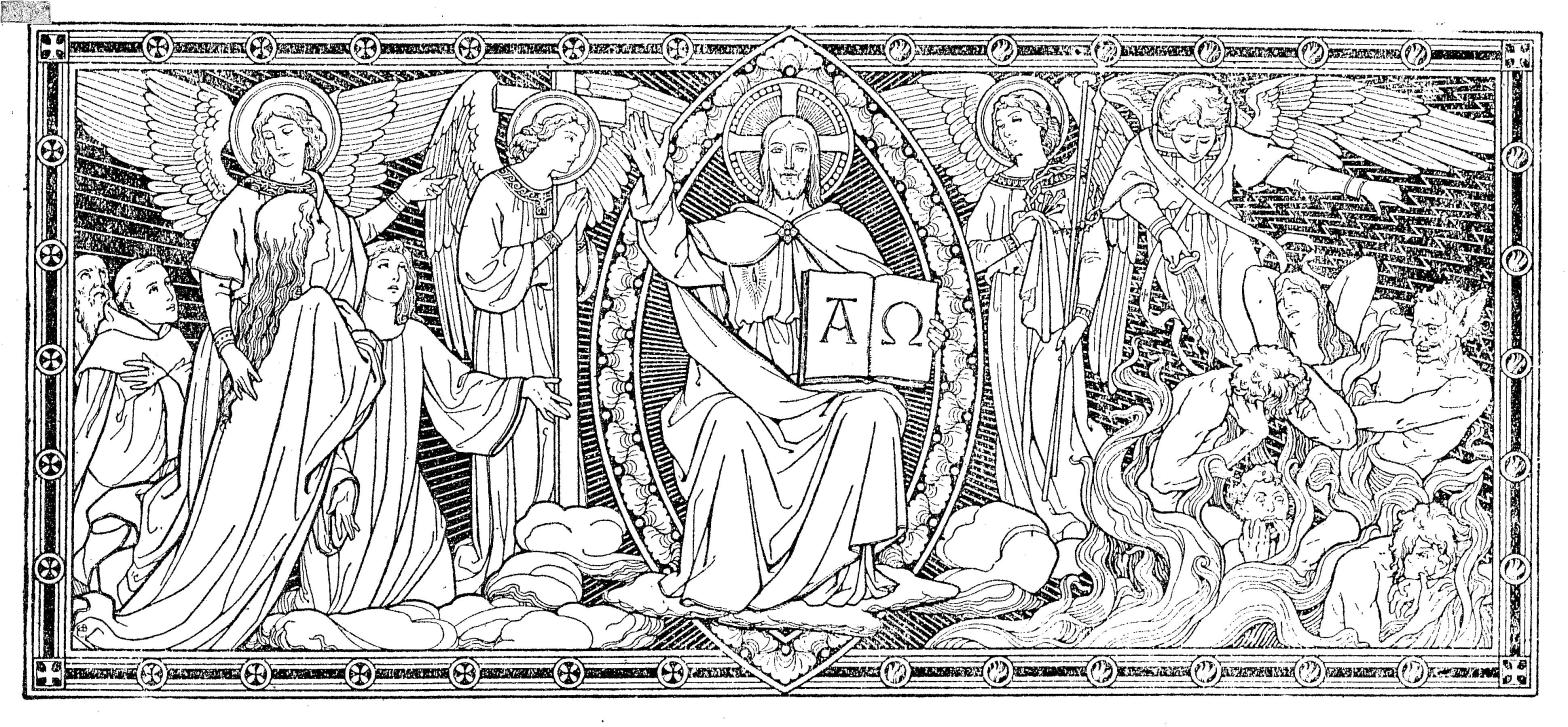
But this order should be seen as the beauty of the universe. It was seen as a gift from God and in a lot of medieval art and paintings. In these paintings, you’ll have God, maybe Jesus sitting on his throne, as in Revelation, or maybe God, the Father with an orb in his hand. You’ll see him on his throne. And then around him you have the angels, the highest of the hierarchy of creation, the highest beings that were created by God. Beneath them are the saints. A lot of times the saints will be ordered in their own categories. You’ll have the doctors of the church, the great teaching saints. You’ll have the martyrs, you’ll have the saints who lived a holy life. You’ll have a lot of times in the Order of Saints, you have kings and queens who are saints, but they’re like the very bottom because the medievals understood that power is always a rough fit with sanctity. And the medievals would also often include the souls in purgatory, the church penitent. They would even include sometimes in the corner of the painting those who were condemned to hell because the whole universe is ordered by the grace of God.
If we receive hierarchy as a gift from God, as something to be celebrated, our relationship with it changes. It’s no longer as much of a threat and it’s more of a, okay, how do I receive this?
Now, the joy of Christianity is that Christianity can exist in any political system, in any ideology, in any culture, in any era. Even if we’re not in the medieval era where Christianity had a lot more cultural influence, the Lord always gives us the skills to exist in whatever system we find ourselves. And so regardless of how you view the concept of hierarchy we have in this gospel, the Lord is basically saying, if you find yourself in a hierarchical situation, if you find yourself at a table where there is a first place and a last place, again, whether it is ordained by humans or ordained by God, whether you think it is a good thing or a bad thing, we all will find ourselves in a world like that.
And the Lord tells us, How do you interact with that? What do you do with that? He says, Don’t seek the highest place. If you find yourself in a hierarchical system, don’t seek the highest place, because especially if you take the medieval view, all gifts are gifts of God, all status are statuses from God. He is the one who gives us our talents, our skills, our merits. If you want to live in a meritocracy, he’s the one who gives us a lot of times our privilege, our economic power, whatever else. All gifts are a gift from God. And so if we unduly try to steal those gifts, if we say, I want gifts that weren’t given to me, I am going to seek that and take it for myself. Then you have all of the corruptions of hierarchy that we rail against. The United States was created as a response to the corruption of monarchy. They had a hierarchy from a medieval system, but it had been corrupted through the Enlightenment. Instead of kings seeing themselves as part of the wider church, kings saw themselves as gods, and that corruption led to horrible things. That corruption led to kings killing kings. It led to courtiers just pushing each other, sometimes literally off bridges. That corruption comes because we seek to take for ourselves something that should be a blessing from God. We seek to make for ourselves a position that was not given to us.
We will be happier, holier and healthier if we simply say, Lord, whatever gifts you’ve given me, I will make the most of them. And then often times the Lord will call us to a higher place. He will develop in us a charism, a special skill, a talent that we can offer. And in offering that charism to the wider community, then we are called to the higher place. We are given a new place, a new status, a new seat. But it’s not for us to seek or to find. It’s for us to pray to the Holy Spirit and say, Lord, whatever you give me, that’s where I will be. Whatever you call me to, that’s where I will act to receive it all as a gift and a blessing. And then, of course, for those who host the dinner, which is to say, for those who find themselves in a place of power, who have the resources to offer something to others, what does he say to them? He says, Use your power for those who don’t have power. If you find yourself in a hierarchical system and if you find yourself at the top of that system, then make sure you don’t use your power to gain more power.
Use your power for those who cannot repay you. To make this very concrete for us, if you have economic power, if you’ve been given wealth or privilege or whatever else – in my case education, born into a family that could send me to the best schools available – if you’ve been given that, you don’t use it to self-aggrandize. Instead, you use it for those who can’t pay you back. You use that power for those with no power. That’s what the Lord’s calling us to. The same is true with education. The same is true with actual power. The same is true as parents. Kids don’t have power on purpose. They’re developing their brains. But you’ve got to use that power for their service.
Again, like I said, Christianity works in any system, in any ideology and any political arrangement. But so does evil. A lot of times when we talk about politics it comes down to specific laws and legislation. But my position follows from Thomas Aquinas. He says you can’t legislate virtue and you can’t outlaw vice. It’s very hard to require everyone to act perfectly, and it’s very hard to outlaw every bad thing that somebody is going to do. Again, regardless of how you think of this concept of hierarchy, whether you think it’s a good thing or whether you think it’s a bad thing, it is always something that can be used for the good or something that can be used for the evil, no matter what system we find ourselves in, no matter how the US is structured, those who wish to do evil will always use hierarchy for their own power and their own self-aggrandizement.
It will always lead to corruption, and there’s very little we can do about that. We can’t outlaw vice. It’s very hard. But on the flip side, Christians can take any system, even if it has injustice, and they can make it just; they can make it beautiful. They can make it serve the purposes of the Lord. No matter who we are, no matter what we have, no matter where we find ourselves, if we follow the advice of Jesus, if we act as Christians in the system that we’re given, then we will see that system serve the Lord. We will see ourselves happier, holier and healthier, and we will see those who need our assistance, those without power, happier and holier and healthier. You only have control over what you have control over. Wherever you find yourselves is where you find yourselves. Use it well, use it like Christ. Follow the Lord’s advice and you will see the blessing that comes from being Christian in the world.
 Fr. Moore