
On April 15, 2026, I submitted an editorial to Cascadia Daily News on school funding. (Link)
Editorial
Editors,
Democracy requires robust debate, so allow me to provide a counterpoint to the claims that our legislature is underfunding our public schools.
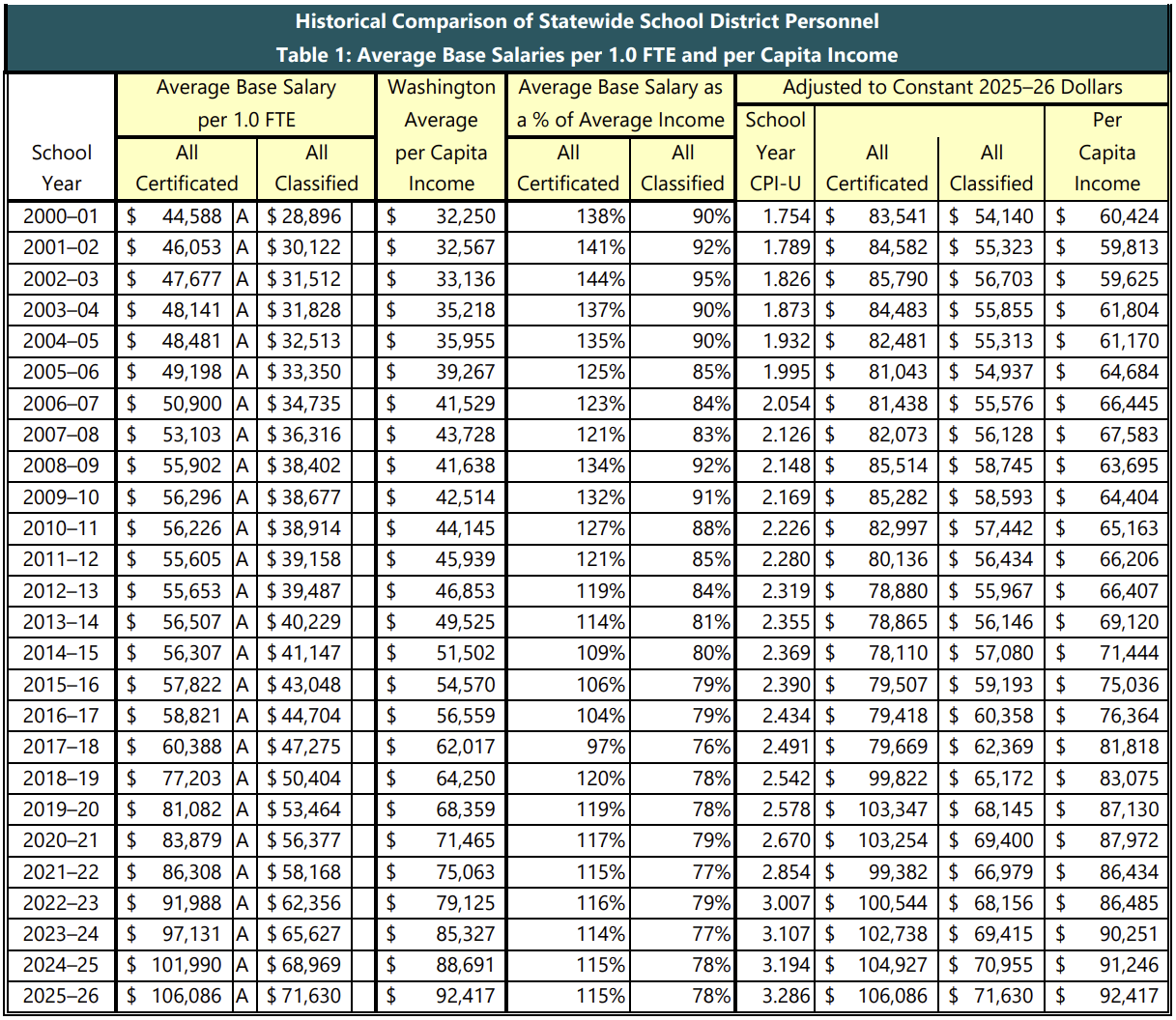
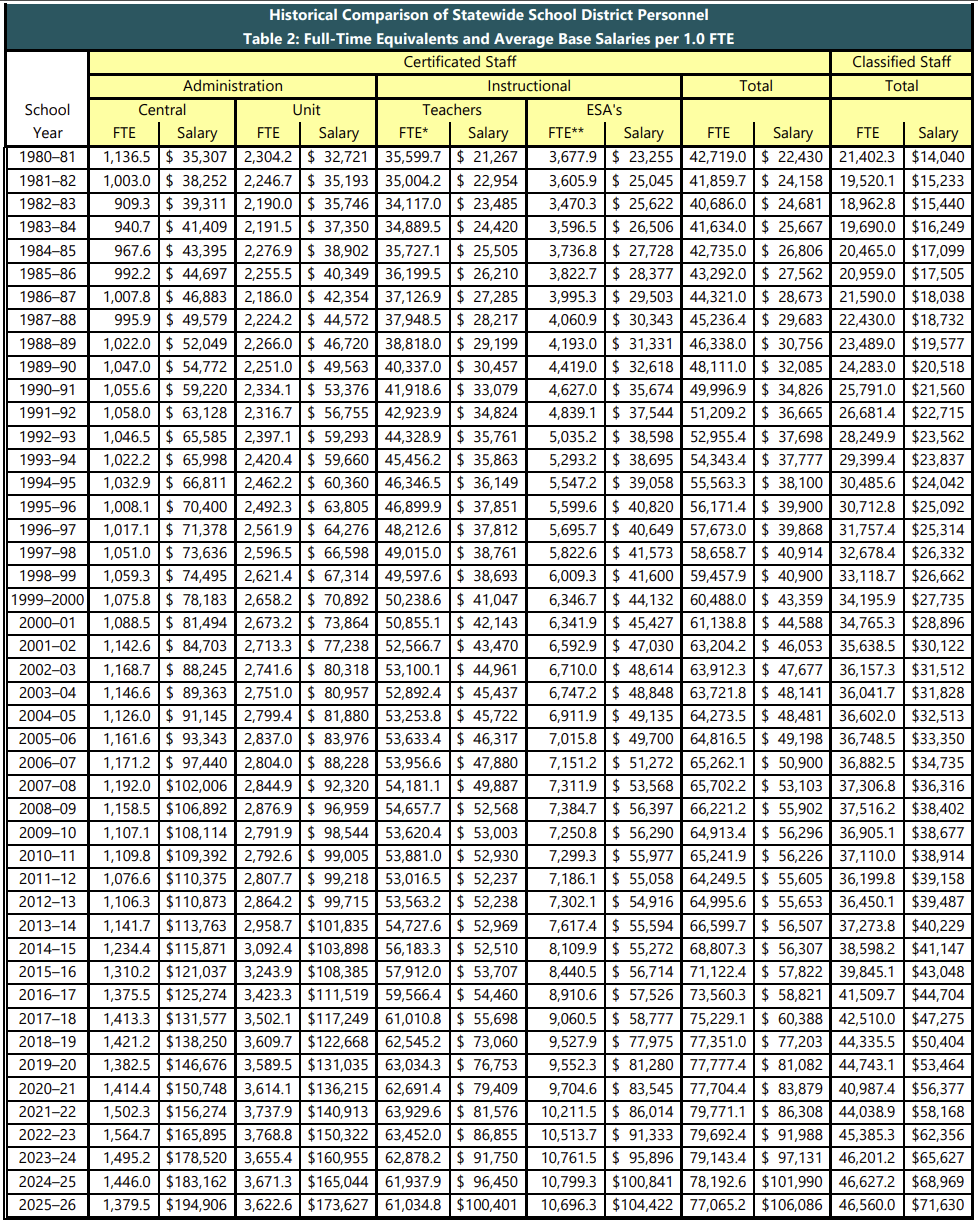
The current “crisis” is directly attributable to the unsustainable increase in salaries following the 2018 resolution of the McCleary decision. In the 2019 school year, the average certified teacher saw a 25% increase in their real dollar salary (OSPI Report, Page 14). This constitutes the majority of the 31% increase above inflation adjustments over the last 20 years. Add this to the 19% increase in certified staff FTEs over that same 20 years (ibid, Page 15) and of course you are going to experience a budget crisis.
We are only seeing the effects of this short-sighted ballooning now because, from 2020 to 2024, our schools were being buoyed by the $190 billion in ESSER (COVID relief money) allocated to K-12 education by Congress. Now, finally, we are having to face the reality of the decisions we made in 2018.
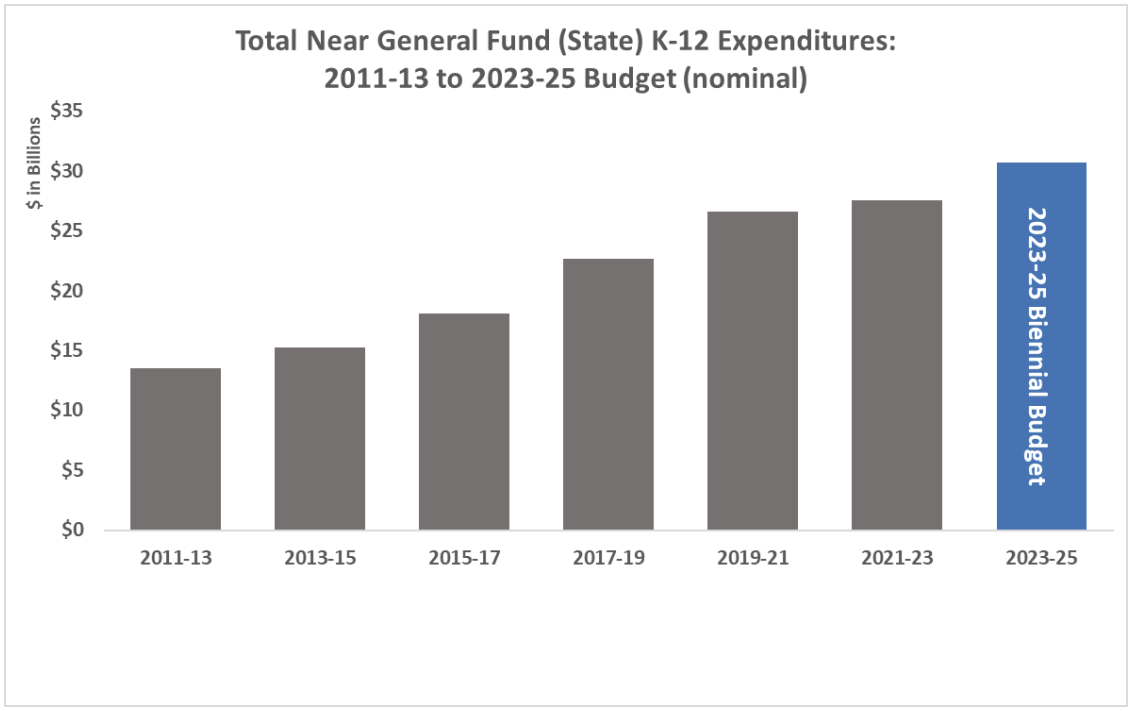
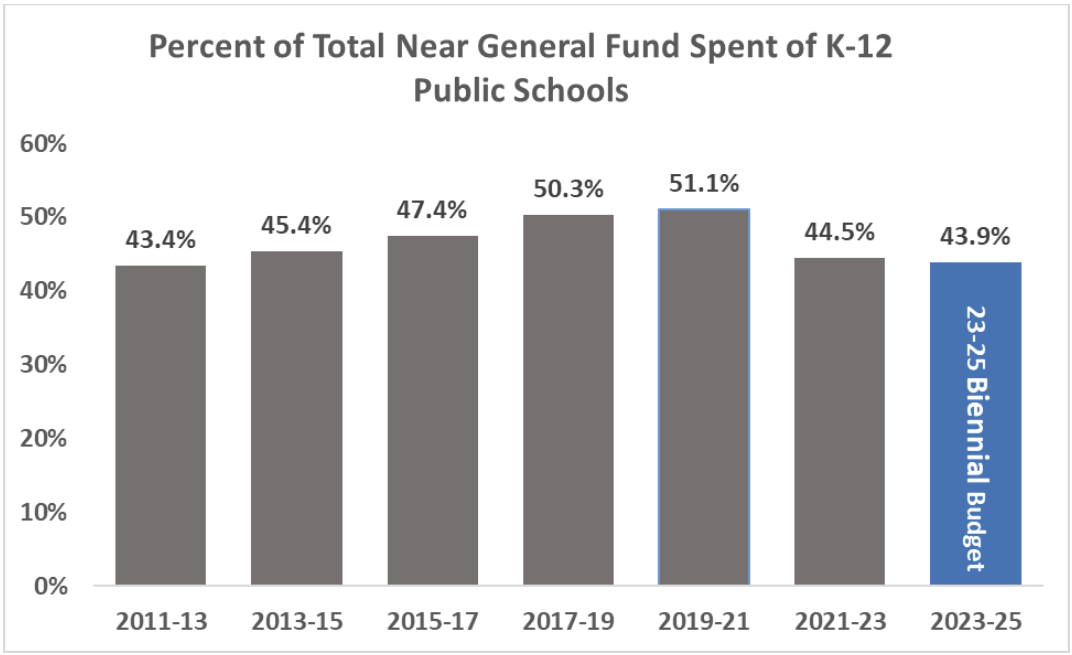
Some will highlight that the total share of state money allocated to education has dropped from 51.1% in the 2019-2021 biennium to 43.9% in the last biennium. I would counter that the dollar amount of funding has doubled (from $14b to $30b) in the last 12 years (LEAP Report, Page 19). The percentages speak more about ballooning state bureaucracy than dedication to education.
I run a non-governmental school with no state money. Quality education does not require higher taxes.
-Rev. Jeffrey H. Moore, Ferndale
Further Commentary
I was limited to 250 words, so here is some additional context and commentary.
Is it really appropriate for a priest to be commenting on politics?
Yes, for a few reasons. But with the super important caveat that nothing in this editorial should be seen as a representing any official Catholic position. This is a personal commentary, and faithful Catholics of good standing are free and encouraged to disagree with me.
Reason #1: I did not sacrifice my citizenship when I was ordained. I still have a personal responsibility to uphold and foster my civic society, and in a democratic society that requires discussion and debate.
Reason #2: Religion is an integral part of a healthy civic society. Kill the churches and you kill everything else. As such, religious leaders have a responsibility to be engaged in civic society and especially to represent the teachings and needs of their churches and congregants.
Reason #3: Our churches serve more than just our congregants and Assumption Catholic School is a prime example (with just short of 30% non-Catholic enrollment). Anything school-related affects more than just the worship that happens in our pews.
Why spend limited social capital on commenting on school funding?
A significant aspect of my administrative work as Pastor of the Whatcom County Catholic Churches is overseeing Assumption Catholic School. I am constantly worrying about paying our bills, strengthening our programs, and recruiting quality teachers. So when I see letter after letter after letter in our local newspaper claiming that our public schools are underfunded and that this is a moral failure by our legislature, I start to get frustrated. If they spend twice as much per student as we do, and we receive zero state funding, then what level of societal moral failure are we experiencing?
Healthy democracy requires debate and this pervasive underfunding narrative needed to be challenged. I am one of a very few people in this county who knows what it takes to run a school without government funding, so I thought providing my perspective was a worthwhile service to my local community.
Do I think teachers ought to be paid less?
Kind of. I highly value teachers and the teaching profession. I not only respect but love – and feel deep camaraderie with – my teachers at Assumption Catholic School. Teachers must be paid a just and living wage. And I would really, really like to pay my teachers more.
However, public teacher salaries have become completely decoupled from market forces following the McCleary decision. We non-governmental schools used to try to pay our teachers at least 90% of what their public colleagues made, and this has become absolutely impossible since 2018. My school still has to balance its budget and be responsive to economic realities, and it is massively disheartening to see our public districts lose any connection or accountability to real life.
As one example, the OSPI chart I reference above and reproduce below shows that the average public teacher makes 115% the average salary in Washington State. The state that hosts Microsoft, Amazon, Boeing, and so many other global economic behemoths. Is it cruel or unreasonable to maybe set our standard at 100% the average Washington State salary?
Referenced Charts
From: https://ospi.k12.wa.us/sites/default/files/2026-02/allpersonnelsummaryreport2025-26.pdf
From: https://fiscal.wa.gov/PublicationsAndReports/K12%20Booklet_2024%20Update%20Final.pdf


How sad that Father Moore is commenting on public schools and teachers’ salaries. Unlike private schools, public schools include ALL kids. Public school teachers are dealing with kids that have a variety of issues often with no extra training provided. At times teachers are the only advocate a child has. Public schools are the equalizer for our society. Talk about life giving- walk into a public school.
Anne Marie Peach