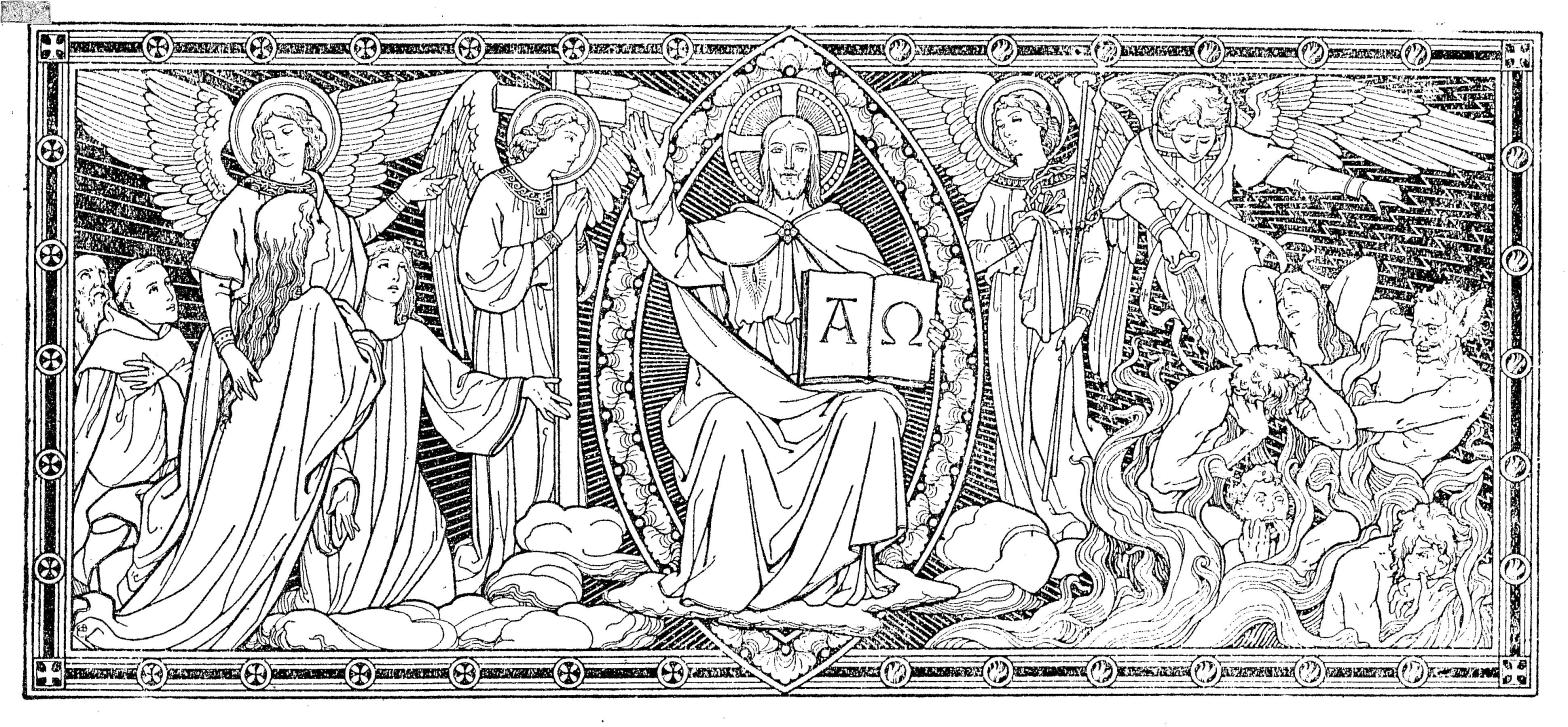
Solemnity of Our Lord Jesus Christ, King of the Universe
Previous Years:
Preached at the Church of the Assumption in Bellingham, WA
Recording
https://moorejesus.podbean.com/e/the-king-goes-first/
Transcript
If you didn’t pick up on it, this Gospel is where we get six of the seven corporal works of mercy. The final corporal work of mercy is to bury the dead. So, if you have somebody’s ashes in your closet or on your mantle, bury the dead. But otherwise, these are the other six. What’s interesting about this is that Jesus is using these corporal works of mercy as the standard by which He is going to judge the nations. And yet, if you read through the Gospels, I can hardly think of any instance where Jesus actually did these things Himself. He sent a messenger to John the Baptist when he was in prison. He certainly healed the sick. He ate with tax collectors and prostitutes, but these were not people without food. They had food; they were just sinners and exiled by their society. And so, Jesus is judging the nations by something He Himself did not do in His earthly life. Where does He get off? Well, the next ten minutes are me trying to explain where Jesus comes from with this.
To start, I think we have a flawed vision of kingship, and that is a detriment to us in understanding the Feast of Christ the King. When we think of kings, we think of the English kings during the American Reformation or the American Revolution. We also think of King Charles III. But in both cases, these are men who sat on a throne because they were born into the right family, in the right birth order. They did nothing to earn the kingship. By the time we engage with kingship as Americans, we are looking at a bureaucratic institution, a constitutional institution that’s necessary for the self-conception of a nation, but is not in any way meritorious—just something of a figurehead.
Instead, we have to go back to the Davidic version of kingship. David goes out on campaigns for the sake of his people—or at least when he’s well-behaved. The biblical king is a protector; he repels those who would do damage to the people that he is entrusted with. So, when he comes home and he makes a claim on the lives and the livelihoods of the people in his country, it is because they literally owe him their lives. Without the king, without the protector, they would have nothing. They might not be alive, they might have been overrun by their enemies, or at least they would not have freedom and security. And so, the king is able to make a demand on the people, because the king himself has already had to self-sacrifice, to give himself up for them. And having made that self-sacrifice, he can then make a demand on the people. The principle here is the king always has to go first. Whatever a king does, whatever a good king does, he goes first and then he asks the people to follow him. Really, the best analogy we have isn’t the British kings that we’re all thinking about all the time, but it’s General Washington. There is a reason that after the American Revolutionary War, Washington was the first president of the country. Everybody in the country attributed their freedom to him. And they said, because we owe you everything, be our leader. That’s what we think of when we think of biblical kingship, and the kingship of Christ. The principal is the king has to go first.
And so, when we talk about Christ being the victor, as we sang in our first hymn, Christ being victorious, we ask, well, where has He gone? He has gone to the cross. He took upon Himself all sin. He precedes us into sin, not personally culpable because He’s perfect, but taking upon Himself all the consequences of sin. And then He dies. He precedes us into death and wins the victory over death through His resurrection. Christ has gone into sin and gone into death, and He’s won the victory. He has gone before us. So now when we go into sin and when we go into death, we benefit from the victory that has already been won by our King. And because of that, we owe Him. We owe Him for that victory. Death no longer has power over me, only because Christ has conquered it. If I want to live eternal life, if I want to give thanks for the gift of eternal life that I’ve been given, that thanks goes to Christ. I honor, I worship the King on the cross who gave me that victory. Similarly, every anxiety that we have, every enemy of humanity, every problem that we face, Christ has gone before us and won the victory. There is nothing that can harm you. There is nothing that has power over you because Christ has won the victory over everything. As Saint Paul says in our second reading, For he must reign until he has put all his enemies under his feet. The last enemy to be destroyed is death. If death has no power over Christ, what can possibly have power over Christ? Death is the most powerful enemy you can imagine. And so, Christ reigns over all the enemies of humanity. All of the enemies of humanity are under His feet.
But then, very interestingly, Saint Paul continues, When everything is subjected to Him, then the Son himself will also be subjected to the one who subjected everything to Him, so that God may be all in all. We owe our victory to Christ. We owe our eternal life to Christ, but we also owe our life—just the mere act of existence—to the Father. In the Trinitarian relationship, the Son receives everything from the Father, and so, Christ acknowledges that even though He has won the victory, He also owes His victory to the Father. Thus, at the end of time, all of the enemies that Christ has conquered, all of the subjected nations and kingdoms, are then offered finally back to the Father, so that God may be all in all. The One who gives us everything, including existence, receives back everything in existence.
So how do we get from here to the corporal works of mercy to our Gospel? Well, first notice that in our first reading God says, I myself will look after and tend my sheep. As a shepherd tends his flock when he finds himself among his scattered sheep, so I will tend my sheep. The only reason Christ gets to separate the sheep, gets to judge the sheep, is because He was first the Shepherd of the sheep. Christ is the One who gathered us together, who gave us unity in His body, who united all of humanity in Him because He is the Shepherd. Because He is responsible for the well-being of the flock, we can credit to Him the fact that we are shepherded, that we are fed, that we are taken care of. He then also gets to make a claim on His flock. He is the One who gets to judge us; He is the One who gets to put us where we belong. Why does He use the corporal works of mercy to do so? Well, the principle again is the king goes before. So, what did Christ do that we are participating in? He became incarnate. He, God, the Creator of the universe, became a human being. That is radical solidarity with His creation. God decided He wanted to be one of us. And so, He goes before us into radical solidarity. We can’t do that. We are not God, so we can’t make that same level of self-sacrifice—God becoming man. Instead, in this judgment, Christ is giving us an accessible means of radical solidarity. You cannot be God become man; that is not a sacrifice you can make. But you can be man in solidarity with your fellow man. You can be close with those who suffer, just as God was close with those who suffer from sin, which is to say, the entire human race. And so, when somebody is hungry or thirsty, when they are a stranger or naked or ill or in prison, they are suffering. They are suffering from something that they lack, that they ought to be given—just as humanity was suffering from the lack of grace that we were created to receive. Christ is giving us these examples of radical solidarity. And He’s saying, I went before you, I am the King. I have won this victory for you. To participate in my victory, you have to participate in my self-sacrifice. You can’t become God made man, but you can be in radical solidarity with your fellow man.
I would also say, however, the Church, in her wisdom over time, has paired these corporal works of mercy with spiritual works of mercy. The Church has recognized people suffer not just in their bodies—that’s what corporal means—but in their souls, in their spirits. So, to accompany somebody who is in doubt or in error or in sin, to counsel somebody, to be with somebody in their existential dread—that matters as well. What Christ is calling us to is radical solidarity with the people around us. Can I enter into their suffering? Can I enter into their experience? Can I try to bring them relief in that suffering just as God has brought me relief?
As I was praying about this homily, the best analogy I could come up with for why Christ gets to sit on a throne and judge us according to this standard, is parents trying to get their kids to do their chores. Kid maybe crosses their arms and they are like, why do I have to wash the dishes? That’s unfair. I didn’t eat all of this food. Okay, fine. Why do you have to wash the dishes? Well, because your parents are the ones who go to work, bought the house, provided the food, cook the food, and bought the dishes. They have provided everything. And you are simply called to participate in the economy—which is the Greek word for household—they have established. Doing our chores is our participation in the victory that is won by our parents for our economic security. Christ has won the victory over all things and we, like obedient children, are called to participate in His victory. Christ has won the victory over sin and death, and so He has the right to demand of us a life without sin. He has the right to demand of us a life lived according to moral principles. Christ became incarnate in radical solidarity with us human beings, so He has the right to demand of us that type of solidarity with our fellow man. Christ has won all of the victories. We owe Him everything. Are we really going to look our King in the eye and say thank you for conquering all of the enemies of humanity—but I’d rather not participate anymore.
 Fr. Moore
1 Comment